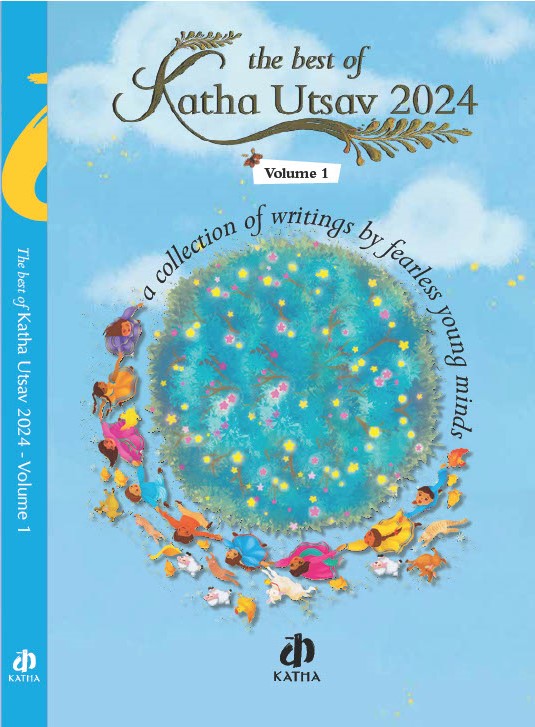
When one puts much too logic in what may be right or wrong, possible or impossible, the creativity is bounded by limitations. However, give children the freedom of expression and their imaginations take wings transcending the boundaries of dos and do-not’s. They create a fantasyland where everything is possible. There is magic everywhere… there is a hope and a happy ending.
And, that is exactly what Katha Utsav 2024 has done by giving a free reign to the children to let them create stories from the heart and share their perspective.
Katha Utsav started in 1991 to share stories from different traditions, regions and cultural experiences from across India. In 2005, Katha expanded to include children for creative expression and mentorship. The children participate in regional workshops with their stories, essays, poetry. The mentors shortlist the promising entries and help the children in honing their skills. In August 2024, at one such mentorship workshop, children from 24 Indian states participated. The book is a compilation of work created by young writers who hail from different socio-economic backgrounds with a common desire to write.
A collection of about 60 stories, poetry, Haiku, the stories range from words by nine year olds to 15 year olds from across the country from metro cities to small towns. The narratives also echo a variety of emotions addressing happiness, dilemma, sadness, loneliness, fantasy, courage and more.
The Mosquito Plan a story by fifth grader Srisha Gannu from Hyderabad is an apt imagination of a mosquito conversing with its peers. With a message at the end of story, it also shows the understanding of a preteen mind for clean surroundings to prevent spreading of diseases. The ‘Story of a Fox’ by Jahnavi Nagesh also a fifth grader from Nazira, is a revelation for parents who hope to provide everything for their child and unknowingly expose the child to stress of excelling at all. With the story ‘Value of time’, Rajdeep Singh of eighth grade from Fattu Bhila village in Punjab shares an important life lesson with his peer group about utilising the time at hand for a successful tomorrow.
Haiku is a Japanese form of poetry with just three lines. A picture emerges in just fifteen to seventeen words. It is not an easy form of writing as it seems but some of the children like Dhaswant N and Harini KR of ninth grade from Coimbatore, have attempted the form quite wonderfully in the book. Poetry by Parneet Kaur of fifth grade, Radhika Vaid and Sanjana of class nine, are worth mentioning.
As a matter of fact each child’s contribution to the book is excellent and praiseworthy. The book has some very sweet, unfiltered, innocent stories that give a glimpse of myriad thoughts that may be crossing the young minds, who are on the threshold of crossing into the world of adults. Some of these fledgling authors will probably be the next great novelists, lyricists and journalists.
The book is a great initiative by the Katha Utsav in hand holding the young writers and introducing them to the world of self-expression. For the children who were shortlisted, it is a wonderful achievement and for those who could not be included, the book is an inspiration to keep trying their hand at writing and become better. The book is also a request to parents to encourage their children in dreaming and expressing their thoughts in an unrestrained manner, to make reading a habit and explore the world through words. The book is a trophy for the diligent teachers of hundreds of schools who work hard to shape the children into confident narrators and storytellers.
Let us make our children confident and aware by being brave in penning what their heart says.
 Among the two other books ‘Karna’s Wife’ and ‘Sita’s Sister’ by Kavita Kane, I have read only ‘Sita’s Sister’ a story of Ramayan from the viewpoint of Urmila, Lakshman’s wife and Sita’s Sister. Ramayan being the story of Ram and Sita, Urmila has only little role to play in the epic yet in author’s story Urmila becomes the protagonist and retells the story from her perspective.
 Shoma Abhyankar